
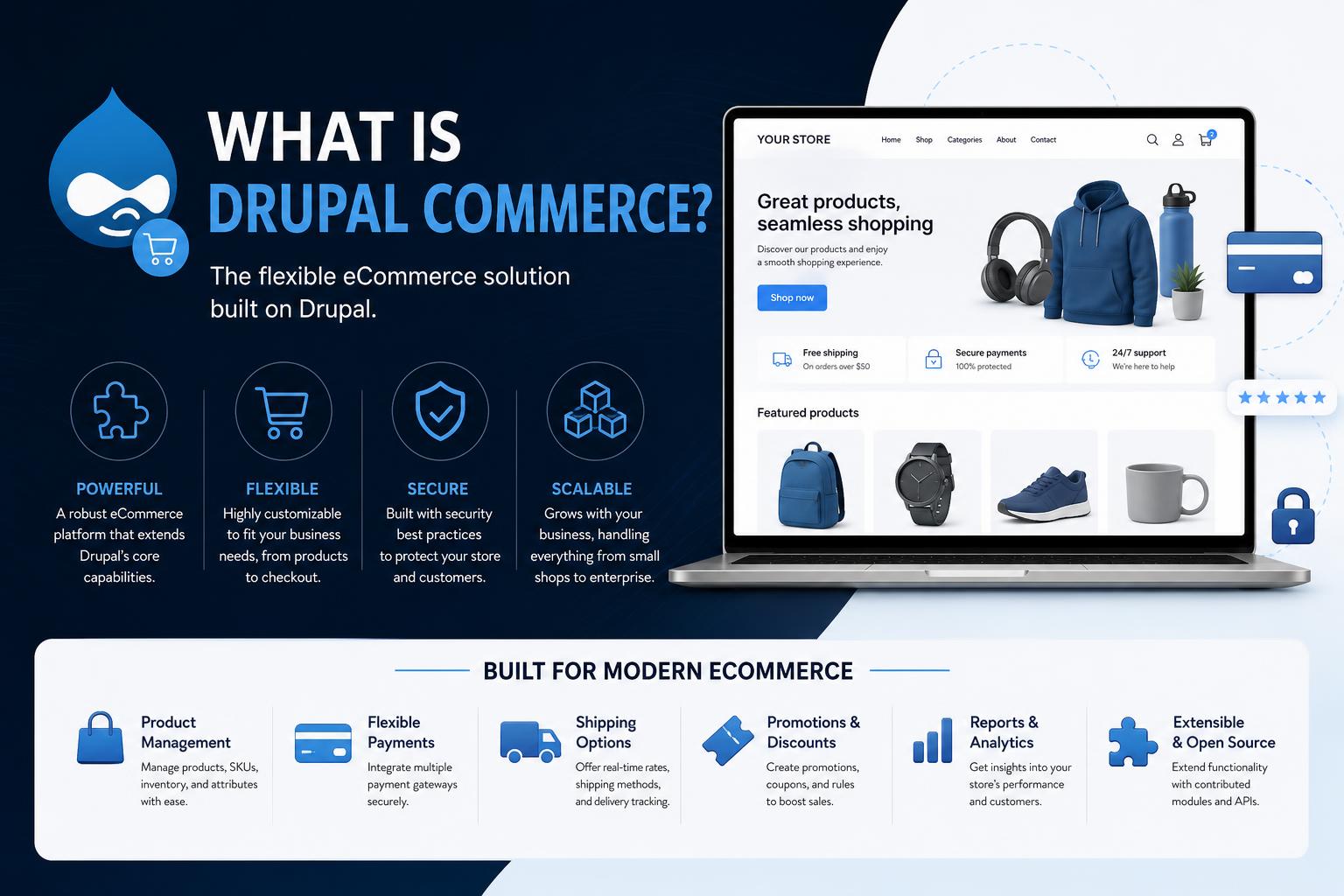
- Drupal Commerce stands out as a robust, flexible open-source eCommerce framework that deeply integrates with Drupal’s CMS, empowering merchants to create custom, scalable online stores.
- Its immense modularity and extension ecosystem enables advanced functionality in payments, shipping, order management, and content-driven commerce, tailored for businesses of all sizes including B2B and B2C needs.
- With features like headless commerce, seamless content and product workflows, powerful APIs, multi-language and multi-currency support, Drupal Commerce is future-proof and fits both complex enterprise requirements and accessible small business setups.
Trying to figure out exactly what Drupal Commerce is, how it works, and why so many businesses trust it to power their eCommerce operations? The world of online selling is jam-packed with platforms and plugins, but few are as versatile or integrated as Drupal Commerce. Whether you’re launching your first store, running a complex multi-site enterprise, or are simply curious about modern eCommerce frameworks, get ready for an exhaustive deep dive.
In this guide, we’ll break down what makes Drupal Commerce tick, why it’s different from other solutions like WooCommerce or Shopify, and how it leverages the full power of the Drupal Content Management System (CMS). We’ll blend detail with approachability, so you’ll leave with both a practical and conceptual understanding of what Drupal Commerce offers, who uses it, and why it might (or might not) be right for your project.
Understanding Drupal Commerce: The Core Concept
At its heart, Drupal Commerce is an open-source eCommerce framework built on top of Drupal. This means it’s not just a plugin with limited features, but an integrated system that extends Drupal’s capabilities to handle everything a modern online shop needs. The project is led by Centarro (formerly Commerce Guys), with a global community actively maintaining and expanding the platform.
With Drupal Commerce, you can sell any kind of product or service online to audiences worldwide. From physical products and digital downloads to event tickets, subscriptions and services, the framework is designed to handle sales at any scale or complexity level.
Key to its appeal is Drupal Commerce’s flexibility. Rather than locking merchants into rigid workflows, it offers building blocks (entities, fields, and APIs) to construct unique commerce experiences: custom checkout flows, complex catalogs, multilingual storefronts, multi-currency handling, headless setups, and more are all possible. If you can imagine it, you can likely build it—or extend it—with Drupal Commerce.
Main Features of Drupal Commerce
Drupal Commerce is jam-packed with essential and advanced features for modern web stores:
- Product catalog management – Create as many products, categories, and variations as your business needs. Leverage Drupal’s taxonomy to allow multi-dimensional product categorization and filtering.
- Order management – Track, process, and fulfill orders with customizable workflows. Orders, receipts, invoices, and shipment tracking are all handled in a unified interface.
- Payment gateway integrations – Out-of-the-box support and community modules for major payment processors like PayPal, Stripe, Braintree, Authorize.Net, Ingenico, Alipay, Square, Worldline, plus countless regional providers—even cryptocurrency processors and custom payment methods like cash, check, or transfer.
- Shipping solutions – Integrate with shipping carriers (UPS, FedEx, USPS, ShipStation), set dynamic shipping rules, and handle everything from flat-rate to on-demand calculation based on customer location and cart contents.
- Tax and compliance handling – Support for VAT, sales tax, international compliance, and even country-specific tax rules via extensible modules.
- Promotions and discounting – Manage coupons, automatic discounts, dynamic pricing rules, and sales campaigns right from the admin.
- Customer management – User accounts, address books, order histories, authenticated experiences, B2B-specific features like custom price lists and customer groups, and more.
- Extensive reporting and analytics – Integrations for Google Analytics, Facebook Pixel, custom event tracking, conversion analytics, and more.
- Multi-currency and multi-language ready – Perfect for global stores; present products, orders, emails and more in a shopper’s language and native currency, with automatic conversions if needed.
All of this is built on open standards. Drupal Commerce is fully open-source, released under the GNU General Public License, and developed in PHP for cross-platform compatibility. There are no recurring license fees.
Modularity and Extensibility: Customizing Your Commerce Experience
Much of Drupal Commerce’s true power comes from its modular ecosystem. Just as with the core Drupal CMS, your site grows as your ambitions grow: if you need features beyond the core set, you install one of hundreds of contributed modules tailored for commerce.
- Payment and checkout – Add support for specific gateways or payment types. Introduce tokenization for credit card security. Provide guest checkout, custom order steps, or allow purchases without login.
- Shipping and fulfillment – Dynamic shipping price calculators, integrations with local carriers, advanced fulfillment workflows, or drop-shipping management are all available as add-ons.
- Price rules and currency converters – Present localized pricing, enable dynamic discounts by geography, or allow customers to view prices in their chosen currency.
- Sales operations – Tools for promotions, customer reward management, PDF invoice generation, product ratings, favorites, wishlists, and more.
- Faceted search and product discovery – Build advanced shopping filters, integrate with enterprise search solutions like Solr or Algolia, and surface relevant content across your catalog.
- Security and fraud prevention – Two-factor authentication, automated fraud detection, and PCI-compliant workflows help keep stores secure for both owners and shoppers.
If your business demands it, there’s probably a module for it. If there isn’t, you or your developer can build it—everything in Drupal is designed to be extended.
Commerce Kickstart: The Fast Track to Store Setup
For those who want an accelerated path to launching a new store, the Commerce Kickstart project is your superpower. It offers a pre-configured Drupal installation that comes with Drupal Commerce, a hand-picked set of contributed modules, carefully designed themes, and even an optional demo store to explore features in real-time.
This starter kit is perfect for both newcomers and experienced developers: test, customize, and launch faster—without needing to assemble all the moving parts from scratch. You can build on top of Commerce Kickstart or use it as a learning playground before deploying your live online store.
Drupal Commerce in Action: Who Uses It?
Drupal Commerce is trusted by a wide range of organizations—from startups to household names. Notable users (according to various showcases and documentation) include:
- Royal Mail (UK)
- Eurocentres international language schools
- McDonald’s France
- Lush
- Guerlain
- Fooda
- URBANY’S
- Olsson & Gerthel
- QDOS
- Bellame
Thousands more mid-sized and small merchants run their businesses using Drupal Commerce, from content-driven publishers to complex B2B manufacturers and agile, fast-scaling startups.
What Makes Drupal Commerce Different?
Perhaps the biggest differentiator is how tightly commerce features are woven into Drupal’s best-in-class content management system. Unlike other eCommerce platforms where content is secondary (often requiring extra apps, plugins, or even a separate site), with Drupal Commerce:
- Content marketing is seamless: Landing pages, SEO-optimized blogs, product tutorials, case studies, user-generated media, and editorial workflows all live within a single system—making it easy to build a content-rich shopping experience and drive organic traffic.
- Flexibility is the rule, not the exception: Add unlimited product types, custom content structures, and user roles. Run one site, one codebase, one set of updates, and present a unified interface to both your customers and your admin team.
- Authenticated user experiences are robust: Customer portals, custom pricing, address books, order management dashboards, and even wholesale/B2B workflows are all achievable without third-party dependencies.
- It’s developer- and business-owner-friendly: You have full control of source code, system architecture, and workflows. Build advanced, custom features yourself or tap into the vast library of contributed modules.
Synergy of Content and Commerce
For businesses where both content and product are central, Drupal Commerce enables incredibly deep integration.
- Educational sellers: Vendors selling digital publications, certifications, or online learning can connect vast reference libraries, documentation, and FAQs with products, helping visitors self-educate and make informed purchases.
- Complex products or customizations: Need custom product configuration, request-a-quote, or buyflows tailored to unique manufacturing operations? All possible thanks to Drupal’s entities, flexible content types, and highly configurable workflows.
- Wholesale and B2B: Issue purchase orders, set up customer-specific pricing or portals, control access with granular permissions, and streamline bulk ordering—all from the same system.
Headless Commerce and Future-Proof Architecture
Drupal Commerce is ready for the “headless” era, where your store can power modern frontends like React, Vue, or native mobile apps via APIs.
With support for JSON:API and GraphQL, developers can decouple your shop’s backend, allowing for progressive web app experiences, omnichannel strategy, or rapid experimentation with new interfaces—without rearchitecting commerce logic or product management flows.
Scalability: From Solo Stores to Enterprise Networks
Whether you’re a small business or a global enterprise, Drupal Commerce can scale with you.
- Multi-domain and multi-storefront: Serve different markets, brands, or regions from a single site while tailoring products, language, currency, and payment methods per audience. Each storefront can have its own domain and branding while sharing backend infrastructure.
- Globalization: Translate everything, from content to checkout flows, to support international growth. Automatic currency conversions, region-specific tax and regulatory compliance modules, and more, keep merchants ready for cross-border eCommerce.
Order Management and Checkout Flows
Every shop’s sales process is unique, and Drupal Commerce gives you complete control over the order lifecycle and checkout experience.
- Design custom checkout steps: Define what information a customer must provide and in what order—such as enabling guest checkout, requiring account creation, or gathering data for compliance.
- Workflow management: Orders move through fully customizable states (e.g., placed, paid, fulfilled, shipped). Advanced permissions let only the right team members move orders between states, which is essential for complex or regulated businesses.
- Payments and security: Payment data can be tokenized for security, reducing PCI compliance headaches and providing peace of mind to merchants and shoppers alike.
Integrations: Plug-and-Play and Enterprise-Ready
Need to tie your store into outside systems? Drupal Commerce is built for integration:
- Feeds module for importing/exporting catalog or customer data
- CRM and ERP system integrations
- Analytics, email marketing, social ad systems
- Custom webhooks or APIs to connect with shipment tracking, payment providers, loyalty programs, etc.
This lets you create the “single source of truth” for your business, connecting your eCommerce operations with broader digital marketing or supply chain workflows.
Open Source Ecosystem: Modules, Themes, and Community Power
One of the greatest advantages of Drupal Commerce is access to the giant Drupal ecosystem—over 48,000 modules and contributions from developers all over the world. A few of the most popular commerce modules include:
- Commerce Stripe and Commerce PayPal for payment integration
- Commerce Kickstart for quick store launches
- Commerce Price Rule for dynamic pricing
- Commerce Shipping and integrations with major carriers
- Advanced Currency Converter for multi-currency needs
Unlike typical app stores, most modules are open-source, free, and designed for interoperability—so you can combine features in creative ways without vendor lock-in or hefty licenses.
Comparing Drupal Commerce with Competing Platforms
Why pick Drupal Commerce over WooCommerce (WordPress) or Shopify? While every eCommerce project is different, there are a few consistent themes:
- Deep, native content integration: No need to bolt on third-party content plugins; world-class content management comes standard.
- Unlimited product and content structures: Customize anything—products, blogs, portfolios—for ultimate flexibility.
- Open architecture and extensibility: No premium plugin silos, fewer compatibility nightmares, and freedom to modify source code at every level.
- Total data ownership: Your site, your database, your customer data—no vendor lock-in.
- Lower long-term total cost of ownership: While initial development costs and setup are often higher than SaaS builders, ongoing savings add up because there are no monthly fees per feature, user, or sales volume.
Who Should Use Drupal Commerce?
Ideal use cases for Drupal Commerce include:
- Businesses with unique product structures or custom content needs
- Enterprises requiring B2B portals, multi-brand/multi-region setups
- Publishers selling digital goods or blending content and merchandise
- Companies needing advanced integration with marketing, fulfillment, or CRM systems
- Merchants wanting to future-proof their platform via headless commerce, API-driven expansion, or composable architectures
But it’s also approachable for smaller shops: With Commerce Kickstart, you can launch a full-featured, extensible store without heavy investments in custom code—plus you get the room to grow without switching platforms down the line.
Benefits and Drawbacks
Drupal Commerce isn’t perfect for every situation. Some common pros and cons:
- Pros:
- Tight content-commerce integration
- Powerful permission and workflow capabilities
- Rapid adaptability—change anything, create new workflows, add features as requirements evolve
- No recurring plugin licenses or transaction fees
- Large, global, open-source community
- Cons:
- Steeper learning curve: Initial setup requires some technical knowledge. Admin UI is being improved, but is targeted toward power users.
- Higher upfront costs: Professional Drupal Commerce builds cost more to launch than SaaS stores with turnkey themes; ongoing updates and security are the merchant’s responsibility (or you can contract third-party maintenance), but you have control of the upgrade cycle and hosting.
Future of Drupal Commerce
The project is extremely active, with new features rolling out regularly. Improvements include merchant-oriented changes to order and product management, expansion packs (recipes) for rapid site extension, and vertical-specific site templates for industries like continuing education, legal publishing, or content memberships.
The roadmap includes even more composable architectures, support for Drupal Canvas and AI-driven marketing tools, and a continued focus on lowering barriers for new merchants.
Product and Use Case Examples
Case studies spotlight just how versatile Drupal Commerce is:
- The Irish Times: Launched content-driven subscription sales for their news outlet, streamlining the buying flow and tightly integrating premium editorial content.
- Worthington Biochemical: Maintains vast libraries of products and technical resources, combining commerce and in-depth content to serve researchers and educators with tailored experiences.
- RiffTrax: Built on Drupal Commerce, started with simple digital downloads and scaled to a full digital marketplace featuring community-driven content, live event promo offers, and robust user experience customization.
Many small and mid-sized merchants also choose Drupal Commerce for:
- Unique product configurators (custom build-to-order integrations)
- Multi-currency and multi-language support out of the gate
- Free, open-source access—growing without barriers or forced migrations
Support, Documentation, and Community
Getting started, learning, or troubleshooting in Drupal Commerce is straightforward:
- Official documentation includes user and developer guides, feature overviews, and demos for both beginners and advanced users.
- Community forums and project site allow for technical Q&A and discussion with both experts and the maintainers themselves.
- GitHub repository for reporting issues or contributing code.
- Professional support and consulting available from Centarro and a broad network of experienced Drupal agencies around the world.
Ongoing security releases for both Drupal core and commerce modules, combined with a strong open-source ethos, means stores stay secure and up-to-date as the landscape evolves.
With its unique blend of content power, eCommerce flexibility, and extensibility, Drupal Commerce is a go-to choice for businesses that take growth, innovation, and ownership seriously. It’s equally capable of powering rapid launches for new entrepreneurs and supporting intricate operations for global enterprises. If you want a solution that grows alongside your business, adapts to any market, and never hides features behind premium plugins, Drupal Commerce is worth exploring. There’s a reason thousands of mission-critical eCommerce sites trust it every day—and with new features landing regularly, the future looks even brighter for anyone building their store on this rock-solid open-source foundation.