
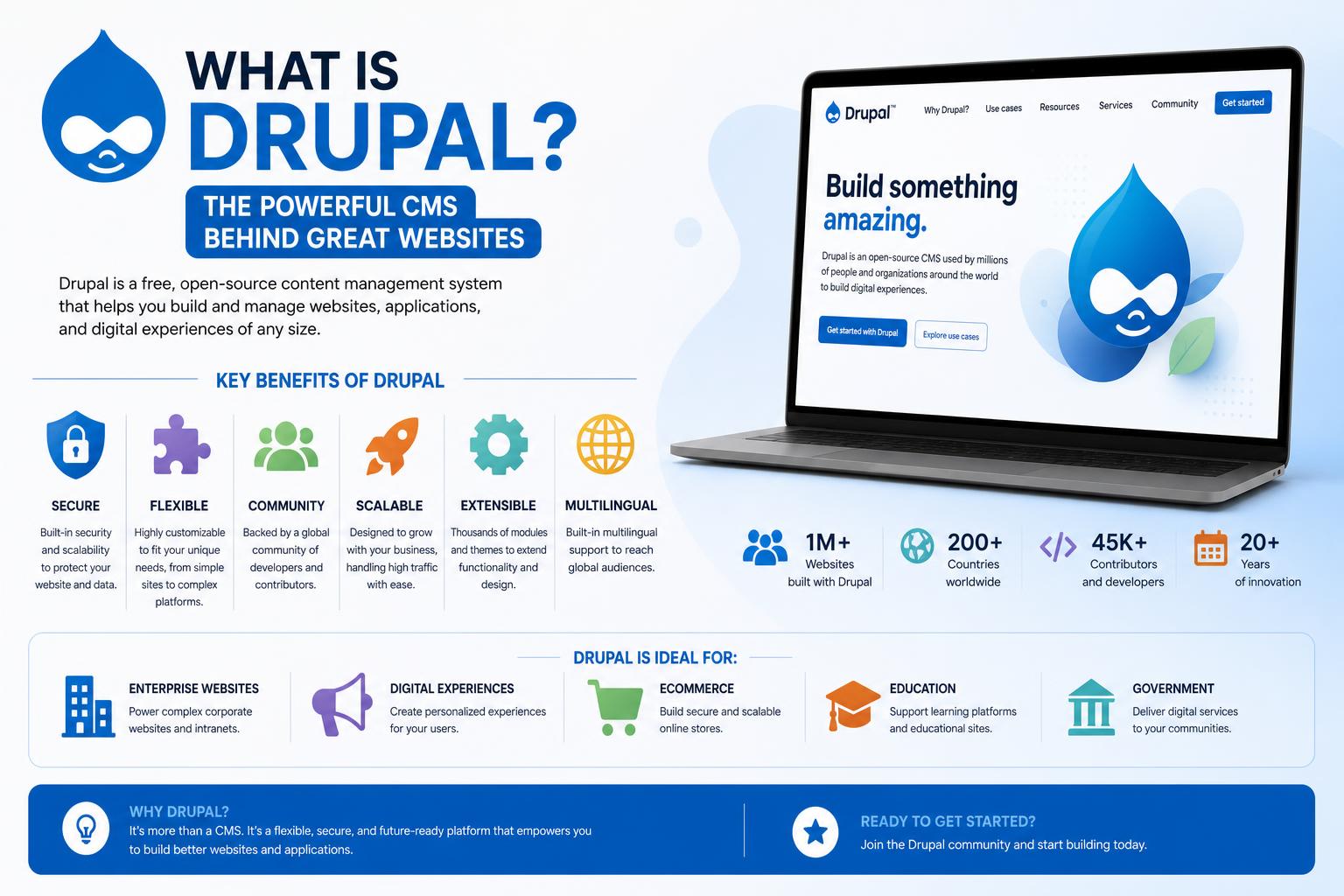
- Drupal is an open-source, highly flexible CMS trusted by governments, corporations, and nonprofits worldwide for building scalable, secure digital experiences
- Its modular and composable architecture allows organizations to tailor, extend, and future-proof websites and applications without vendor lock-in
- Drupal stands out for enterprise-grade security, robust performance for high-traffic sites, and increasing user-friendliness thanks to new no-code/admin tools
When you first stumble upon the question, “What is Drupal?”, you’re not alone. Whether you’re a tech enthusiast curious about open-source platforms, a business owner investigating your next website move, or just someone spotting Drupal stamped across the bottom of some of the world’s top websites, understanding what Drupal is and why it garners such devoted fans is something worth digging into.
In this guide, we’ll go way beyond just scratching the surface. You’ll find answers not only to what Drupal fundamentally is but why it stands out in the ever-noisy world of content management systems (CMSes). By the end, you’ll have the clearest, most comprehensive picture possible—from its history and architecture to why giant corporations, universities, governments, and nonprofits put their trust in Drupal.
What Exactly Is Drupal?
Drupal is a robust, open-source content management system (CMS) engineered for building, managing, and scaling diverse types of digital experiences. Born in 2001 as a small message board project developed by Dries Buytaert at the University of Antwerp, it has grown into a powerhouse adopted by everyone from presidential campaigns to Fortune 500 companies.
At its heart, Drupal is written in PHP and runs on the familiar LAMP (Linux, Apache, MySQL, PHP) or LEMP (Linux, Nginx, MySQL, PHP) technology stack. The core software is freely distributed under the GNU General Public License (GPL), and it upholds the philosophy that software should be open, accessible, and endlessly adaptable.
Whether you want to construct a nimble blog, an online store, a corporate intranet, or a government service portal, Drupal’s modular, scalable architecture means your site can start small and evolve with minimal constraints. And if you’re wondering whether it’s just for techies or coders—surprise, it’s increasingly friendly for non-developers too (more on that soon).
Where Did Drupal Get Its Name?
The story behind the name “Drupal” is as quirky as it is emblematic of open-source culture. Dries Buytaert originally wanted to call his project “dorp” (Dutch for village), highlighting the importance of digital communities. Yet a happy accident occurred when he mistyped it as “drop.org”—and that mistake ultimately led to the English rendering “Drupal,” reflecting the Dutch word “druppel” for “drop.” This lighthearted origin underscores something key: Drupal’s foundation was about fostering community, flexibility, and sharing from day one.
Who Uses Drupal and For What?
You might be surprised at the range of organizations and projects relying on Drupal. It’s far from just a website builder for hobbyists—it’s the backbone for complex projects across nearly every industry. From sprawling government portals to high-traffic media sites and secure healthcare applications, Drupal’s adaptability is unmatched.
- Corporate Giants: Brands like Pfizer, Tesla, Bayer, Citibank, and Nestlé turn to Drupal to power global web presences, internal communication portals, and enterprise resource directories.
- Media & Entertainment: Warner Music Group, NBCUniversal, the Australian Open, Economist.com, and the Olympics have used Drupal for high-visibility, high-traffic digital experiences.
- Government & Public Sector: Agencies like the IRS, NASA, FEMA.gov, City of London, Government of India and WhiteHouse.gov have adopted Drupal for its rock-solid security, scalability, and accessibility.
- Education: World-class universities—including University of Oxford, Princeton University, University of Toronto—use Drupal to manage everything from admissions to alumni engagement portals.
- Healthcare: Hospitals and providers, leveraging compliance features for HIPAA and GDPR, use Drupal for patient portals, appointment systems, and medical resource libraries.
- Nonprofits & NGOs: Organizations such as Oxfam, UNICEF, UNESCO, and Doctors Without Borders use Drupal to manage multilingual, multinational web presences.
Este tamaño o alcance de una organización no limita el uso de Drupal. Es igualmente apto para pequeñas empresas y bloggers apasionados que buscan una experiencia altamente personalizable.
Why Choose an Open Source CMS Like Drupal?
If you’ve heard “open source” and felt unsure what it really entails, here’s the scoop: Open source means the code is freely available for anyone to use, modify, and contribute to. There’s no vendor lock-in or hidden licensing costs. You’re joining a collaborative, global community—and, as a bonus, you can tap into an active ecosystem for support, innovation, and rapid bug fixes. Drupal’s official website has been the hub for this movement for over two decades.
This approach means that organizations save big on licensing, have complete control over their tech stack, and can customize at will. The Open Source Definition guarantees things like free redistribution, transparency, and adaptability—why so many governments and enterprises list these as vital requirements. Plus, a massive free library of modules and themes lowers development costs to nearly zero for basic needs.
The Architecture: How Drupal Is Built
Drupal isn’t just a CMS—it’s also a powerful web application framework. Let’s break down how it works under the hood:
- Core: The “core” of Drupal provides all essential building blocks, such as user account management, menu systems, content creation, and admin tools. This is out-of-the-box functionality, but it can be extended far beyond basic needs.
- Modules: Think of modules as plug-ins that add new features (from SEO tools and e-commerce to analytics and custom workflows). The community has developed over 50,000 modules—making it one of the world’s richest plugin libraries.
- Themes: Want to change the look and style? Drupal themes handle layout, typography, branding, and color schemes. There are more than 3,000 themes to choose from, all customizable to reflect your brand.
- Nodes: These represent individual pieces of content: articles, blog posts, event pages, and more. Each node is fully flexible—letting you define custom fields, attach media, or set up approval workflows.
- Symfony Components: From version eight onward, Drupal leverages robust, reusable libraries from Symfony, modernizing its architecture and improving everything from routing to caching and theming.
The result? A modular, scalable structure where you can choose exactly what you need, replace or upgrade pieces over time, and keep your system future-proof.
Composing and Extending Your Website with Drupal
Drupal’s architecture is more than modular—it’s composable. That means everything from page content to navigation blocks to entire workflows is reusable and adaptable. Developers can assemble complex digital experiences using existing modules, configuration, and pre-built components—speeding up site launches and reducing redundant work.
Let’s say your university site wants to add a course catalog, a news section, and a job board. With Drupal, each feature can be a module or a site component—waiting to be snapped in, customized, and deployed wherever needed. No need to reinvent the wheel.
Main Features That Set Drupal Apart
After two decades of refinement, Drupal packs a vast array of features. Here’s where it really shines:
- Flexibility: You can build everything from a simple one-pager to an enterprise-level digital platform integrating dozens of back-end systems. For example, the state of Georgia migrated over 50 agencies onto a unified Drupal platform, letting each agency control their brand yet maintain technical consistency.
- Scalability: Drupal is ready for high-traffic, mission-critical situations—from millions of pageviews during the Olympics to nationwide election coverage. Load balancing, CDNs, advanced caching (BigPipe, Redis, Varnish), and multi-region failover keep things speedy and resilient.
- Security: Enterprise-grade protection includes role-based access controls, robust encryption, and a dedicated security team that constantly monitors and patches vulnerabilities. Compliance features cover GDPR, HIPAA, CCPA, and FedRamp—reasons why banks, health systems, and governments trust Drupal with sensitive data.
- Multilingual Capabilities: Out-of-the-box, Drupal supports over 100 languages, right-to-left scripts, and automatic translation tools—crucial for global brands, universities, and governments serving international audiences.
- Accessibility: Drupal aligns with WCAG 2.1 standards, supports a wide range of assistive technologies, and incorporates best practices into both the authoring environment and published content. This is crucial for public sector compliance or inclusive design.
- Headless & API-first: You can power a site traditionally, use it as a headless CMS (serving content via API to front-end apps), or go hybrid—enabling innovative uses like mobile apps, Progressive Web Apps, kiosks, IoT devices, and more.
Breaking Down Drupal’s Ecosystem: Modules, Themes, and Distributions
Modules: Extending Core Functionality
Drupal modules are plugins that allow you to add, tweak, or replace nearly every aspect of your site’s behavior. There’s a module for almost everything you can imagine: ecommerce, SEO, advanced search, CRM integration, community forums, user permissions, analytics, custom forms, social media sharing, marketing automations—the list goes on.
- Popular Modules:
- Views – Create custom lists, tables, and filtered displays from any content type.
- Panels – Build complex layouts visually.
- Rules – Automate workflows and site behaviors (think ‘if this, then that’ for your website).
- Media – Streamline management of images, videos, and files.
- SEO Tools – Clean URLs, meta tags, sitemaps, and structured data support are all easily enabled.
Themes: Crafting Your Site’s Look & Feel
Themes dictate the user-facing design of your Drupal site. Whether you want a slick corporate portal, an artsy portfolio, or a no-nonsense government interface, there’s a theme for it. Modern themes leverage the Twig templating system for cleaner, more maintainable code—and many come with responsive, mobile-friendly layouts by default.
Distributions: Fast-Tracking Niche Solutions
Distributions are pre-packaged Drupal bundles designed for specific use cases (online stores, newspapers, nonprofits, etc.). They save time by including relevant modules, configuration, and themes out of the box—so you can hit the ground running with minimal setup.
- Example: A university might start with an education-focused distribution, only needing minor tweaks to go live with student portals, course listings, and faculty profiles.
Who’s Behind Drupal? The Global Community & Professional Support
Drupal’s secret sauce isn’t just technology—it’s the vibrant, worldwide community driving its continual improvement. Over 1.39 million registered members collaborate on new features, bug reports, security patches, and documentation.
Community events include DrupalCon (main conferences), regional DrupalCamps, and countless local meetups. These gatherings fuel innovation, foster career networks, and ensure Drupal is always evolving.
Professional support comes from both core maintainers and a vast web of digital agencies like Acquia, Lullabot, and countless others that build, maintain, and host Drupal sites for clients worldwide.
How Drupal’s Security Stands Out
Security is often why governments, the healthcare sector, banks, and even NASA use Drupal. Not only does it ship with robust security features—such as encrypted user data, access controls, and advanced audit tools—but it also has:
- A dedicated global security team issuing frequent advisories and patches.
- Automated update notifications that warn admins when it’s time to update modules, themes, or core files.
- A disciplined approach to vulnerability management, with a public database and mailing list for all security releases.
- Programmatic features like database abstraction, which shields against most common SQL-injection attacks, and tightly controlled file upload mechanisms.
Big vulnerabilities—like 2014’s “Drupalgeddon” and its 2018 counterpart—were met head-on with rapid patches and community-wide response protocols. The guiding mantra for developers in the ecosystem: “Never hack core,” meaning keep modifications modular for secure, future-proof updating.
Performance, Scalability, and High-Traffic Handling
High-traffic sites demand not just robust hosting but a CMS that isn’t a bottleneck. Drupal delivers enterprise-class speed and scalability through a mix of built-in and extendable technologies:
- Advanced caching: Features like BigPipe stream cached elements first, rendering pages ultra-quick, while Redis, Memcached, and Varnish add further speed-ups in complex environments.
- Horizontal and vertical scalability: Drupal runs comfortably in Kubernetes clusters (EKS/AKS), supports load balancers, and scales up and out as demand grows.
- CDN Integration: Out-of-the-box compatibility with Cloudflare, AWS Cloudfront, and Akamai.
- Performance tuning: CSS and JS aggregation, lazy-loading images, database optimization, and dynamic cache clearing are standard tools for admins.
Is Drupal Only for Developers?
This is a myth that’s been steadily debunked, especially in recent years. While Drupal used to have a reputation as “developer-first,” the platform has evolved with:
- User-friendly admin dashboards that let content creators update pages, blogs, and articles with ease.
- Visual layout builders: The Layout Builder module enables drag-and-drop design—no coding required.
- Point-and-click site configuration: Pre-configured themes, modules, and site templates mean non-technical users can get professional results in less time.
- Low-code and no-code tools: The new Drupal CMS flavor, designed to rival platforms like Wix and Squarespace, comes with pre-built designs, AI helpers, and automated updates—all geared toward users without developer chops.
While ambitious projects may still need developer expertise (for advanced integrations or custom modules), smaller businesses and non-technical teams find managing Drupal sites themselves quite feasible after initial setup.
“Drupal CMS” and the Future of User-Friendly Site Building
Enter Drupal CMS—a fresh approach engineered for the no-code revolution. With pre-configured themes, performance tuning, AI-assisted setup, and auto-updating baked in, non-technical teams can go from zero to polished website in hours instead of weeks. It’s Drupal’s answer to the drag-and-drop site builder craze and lowers the technical bar dramatically.
Unlike classic Drupal (“Drupal Core”), Drupal CMS provides:
- Batteries-included design—choose and customize from a curated library of layouts, components, and visual themes.
- Intelligent onboarding: AI-powered wizards walk you through setup, content creation, and performance optimization.
- One-click updates: Security patches and feature upgrades are installed automatically, letting you focus on content instead of code.
Deep Dive: Who Benefits Most from Drupal?
Enterprises
Large organizations with complex needs lean heavily on Drupal. It streamlines not only the content process—draft, review, approve, publish—but also the entire software development lifecycle. Integrated tools like GitHub Actions, Bitbucket Pipelines, Jenkins, and others can be plugged in, letting dev and marketing teams work in tandem.
With role-based control, granular permissions, integration with analytics and CRM tools (Google Analytics, Salesforce, Epic, etc.), and support for multiple languages, enterprises use Drupal to build digital experience platforms (DXPs) that scale to global audiences and high-traffic surges.
Government
Security, compliance, and accessibility are the watchwords for public sector clients. After the US government moved WhiteHouse.gov to Drupal in 2009, other federal institutions—including NASA, HHS, DOD, FEMA, and more—quickly adopted it. Today, millions of people rely on Drupal-backed government sites for timely updates, important forms, and critical resources—trusting that their data is safe and experiences are accessible to all.
Healthcare
Healthcare organizations choose Drupal to meet requirements on privacy (HIPAA and GDPR), integration (with EHRs and CRMs), and robust role management (such as only clinicians seeing sensitive records). With multilingual portals, appointment scheduling, and personalized patient materials, Drupal ticks all the boxes for hospitals, clinics, and public health campaigns alike.
Education
Universities and K–12 institutions count on Drupal for their:
- Flexible student, course, and faculty directories
- Integration with authentication systems (such as CAS and Shibboleth)
- Multisite management (one backend, many public-facing schools or departments)
Nonprofits
For international NGOs and local charities, Drupal’s zero licensing cost, multilingual tools, accessibility support, and donation integrations make it a go-to choice. Campaigns, blogs, multimedia galleries, event calendars, and volunteer systems can all be spun up or adapted at will.
How Does Drupal Compare Against Other CMS Platforms?
| Platform | Market Share (2025) | Key Feature |
|---|---|---|
| WordPress | 61.8% | Massive plugin/theming ecosystem, easy for beginners |
| Shopify | 6.7% | E-commerce-first, minimal coding required |
| Wix | 4.8% | Visual drag-and-drop builder, AI design tools |
| Squarespace | 3.2% | Designer templates, visual-centric |
| Joomla | 2.2% | Flexible content architecture, multilingual |
| Drupal | 1.2% | Enterprise scalability and security, composable architecture |
WordPress dominates the SMB and blogging market, with rapid year-over-year growth and appeal to those who want to get online fast. Shopify and Wix target e-commerce and beginner website creators, growing especially among small businesses due to ease-of-use. Drupal’s niche is high-stakes, high-complexity sites—governments, universities, health networks, and global brands.
Breaking Down Drupal’s Core vs. Headless vs. Hybrid Architectures
- Traditional (Core): The admin backend is tightly linked with the public-facing website. Best for classic sites, intranets, and projects focused on the web only.
- Headless: Content is managed in Drupal, but delivered via APIs to front-end apps (React, Vue.js, mobile apps, IoT devices). Separates editing from presentation, perfect for omnichannel publishing.
- Hybrid: Combine the best of both—manage via Drupal, serve content to both standard websites and external channels. Enables gradual modernization and future expansion.
Integrations, API-First Features, and Composability
One of Drupal’s biggest strengths is integration with virtually any third-party tool—or the ability to power new experiences as the digital landscape shifts:
- API-first architecture: RESTful and GraphQL APIs are standard. Feed content to apps, microsites, smart devices, or external systems.
- Composable content and tools: Reuse fields, blocks, views, and forms across multiple sites or applications for speedy development and consistent branding.
- Marketing integrations: Connect with Salesforce, Marketo, Mailchimp, and more to automate lead capture, forms, and campaigns.
- Analytics: Google Analytics, Cloudflare insights, Mixpanel, and Microsoft Clarity are a few clicks away from integration for deep reporting.
SEO and Digital Marketing Benefits
Drupal comes equipped with features designed to make your site discoverable and competitive in search rankings:
- SEO Toolkit: Clean URLs, meta tag management, XML sitemaps, schema support, and more (all modular and upgradable).
- Fast, mobile-responsive pages out-of-the-box with built-in performance and accessibility boosts.
- Automatic redirects and structured metadata help preserve search rankings as you reorganize content or update old pages.
- Multilingual SEO: Sitemaps, tags, and hreflang support help your global content rank in every targeted locale.
Upgrading, Maintaining, and Updating Drupal Sites
One of the big advances over the years has been simplifying site maintenance for non-tech users. Drupal can automatically notify administrators of new core, module, or theme releases—ensuring you’re always protected against new threats and have the latest features. With the arrival of Drupal CMS, auto-updates for most scenarios are finally a reality, further lowering maintenance effort for small and medium teams.
Best practices call for regular backups (core files, modules, themes, media, and databases), and many user-friendly tools exist for creating and restoring snapshots quickly if needed. Powerful command-line tools, like Drush, make managing updates (and automating routine tasks) a breeze for those who want more technical control.
Common Questions About Drupal
- Who builds Drupal? The global community! With over 1.3 million registered users and 100,000+ active contributors, improvements, documentation, and innovation are crowd-driven. Corporate sponsors like and a network of agencies support enterprise scalability and professional hosting needs.
- Is Drupal truly free? Yes—free to download, use, and modify. No licensing fees, no vendor lock-in. Some advanced features or support may be paid, but the baseline system is open source with zero cost.
- Can I demo Drupal for free? Absolutely! There are several ways to do this:
- Try a guided online demo with platforms like DrupalForge and Simplytest.me.
- Install Drupal on your local machine (Windows, Mac, Linux) in minutes.
- Use cloud-based sandboxes provided by platforms and some hosting providers.
- Do I need to know how to code? Not anymore! Basic site building, content editing, and design can be handled visually, via admin dashboards, and with no-code tools. For advanced features, integrations, or backend customization, developer help can take you further—but it’s not mandatory for many typical sites.
- Is Drupal secure for sensitive or regulated data? Yes: thanks to its strong architecture, dedicated security team, and proven track record with governments and medical organizations, Drupal is one of the few platforms trusted for high-compliance use cases.
Trying and Launching a Drupal Site
The path from curiosity to live Drupal site is shorter than you might expect. Whether you’re a developer, a marketing professional, or a business owner, you have several options:
- Preview and experiment in Drupal sandboxes: Tools like , Drupal.org, and offer free, no-signup demos.
- Cloud and managed hosting providers: Many offer 1-click installs, automated backups, and performance-optimized configurations.
- DIY installation: Download Drupal, deploy on your server or local environment, and start exploring at your own pace.
Looking Ahead: The New Face of Drupal
Drupal isn’t standing still. Besides the classic platform, the brand-new initiative known as “Drupal CMS” (initially codenamed Project Starshot) was launched to create a more user-friendly, modernized experience—straight out of the box. This project is bringing native AI integrations, built-in performance tuning, and zero-hassle maintenance to non-technical users, all while preserving the flexibility and composability that developers love. For the first time, no longer is there a trade-off between ease-of-use and technological power.
With frequent feature releases, strong backward compatibility, and a continuous focus on accessibility and compliance, Drupal is future-proofing itself for whatever the digital world demands next. From traditional web experiences to cutting-edge digital platforms and progressive web apps, Drupal remains a top pick for visionaries, large organizations, and everyone who values adaptability, security, and control.
Drupal combines a rich history of community-driven innovation, powerful technical architecture, and a commitment to security, accessibility, and composable digital experiences. Whether you need to power an enterprise-scale platform or launch a small personal site, its adaptability and flexibility set it apart—making it the engine behind some of the web’s most ambitious, stable, and innovative digital properties. Beyond technology, Drupal is a continually evolving, global movement with the community muscle to shape the future of digital content and experiences.